


Processing Smarter, Building Faster with On-Site Material Recycling
As infrastructure projects expand into challenging terrains and urban redevelopment gath-ers pace, on-site material processing is becoming central to efficient project execution. Guido Azzolin, CEO of MB Crusher, discusses how attachment-based crushing and screening technologies are helping contractors improve productivity, reduce logistics costs, and support circular construction practices across diverse project environments. -Guido Azzolin, CEO, MB Crusher India Pvt. Ltd.
How is MB Crusher pursuing global growth strategy?
Global growth at MB Crusher is not pursued through volume alone. The strategy is built around application depth in markets where what we do solves a real and recurring problem. We operate in over 150 countries through a network of more than 950 dealers and nine international subsidiaries — in the United States, Brazil, Germany, France, Japan, Indonesia, and India, among others. That structure gives us local engineering capability, not just distribution logistics.
The discipline behind that network matters. Every market where we establish a presence requires a service infrastructure that can sustain it.
India illustrates what we consider the right approach. We have been present here for over a decade, accumulating application data from granite-heavy terrain in the South, seasonal basalt conditions in Maharashtra, dense urban demolition sites in metro corridors, and remote infrastructure projects in the Northeast. That field data has directly influenced how we tune product parameters and where we focus our service investments. It also shapes how we approach other markets: what the local geology is, what the carrier fleet looks like, how operators are trained.
Global expansion is, at its core, a question of whether you can deliver on the promise of on-site processing reliably. The technology is proven. Execution is what differentiates positions.
With increasing emphasis on resource efficiency and circular construction, how do crusher and screening attachments help contractors maximize material reuse on-site?
The principle is straightforward, though its operational significance is often underestimated. Material already present on a demolition or construction site has embedded value — but that value is only captured if the material can be processed where it sits. The conventional alternative is to transport it elsewhere, which adds cost, logistics exposure, and time without improving the material itself.
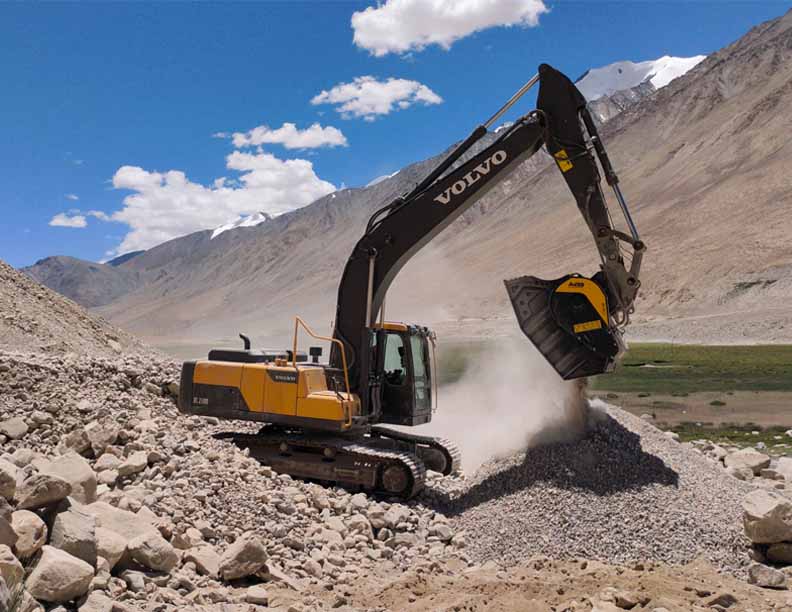
A crusher bucket eliminates that dependency. It mounts to the excavator, draws hydraulic flow from the carrier’s existing circuit, and reduces material to required output size in a single pass. The Hardox structural frame contains the crushing forces and protects the carrier’s boom geometry. On a busy urban demolition site, that makes a measurable difference to cycle efficiency.
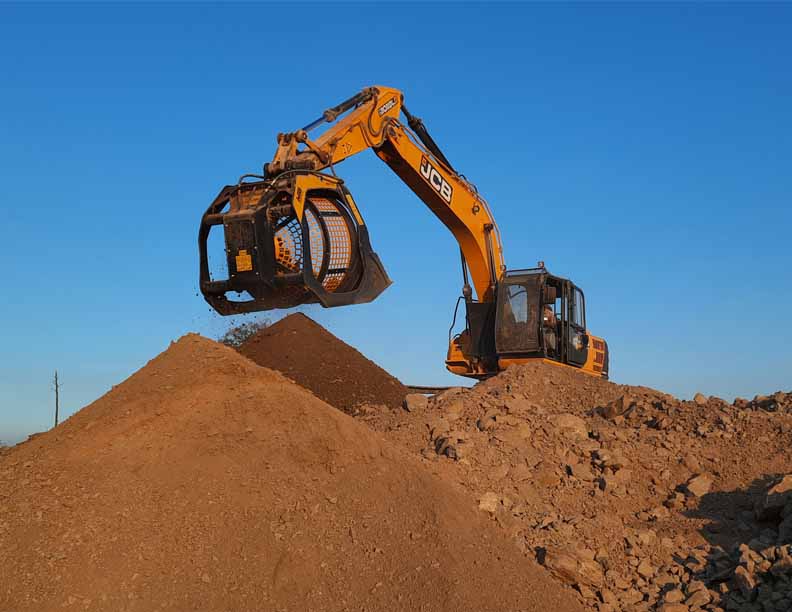
Screening completes the process. A contractor who crushes demolition debris and then screens the output can classify material to road specification — sub-base at one setting, drainage fill at another — without moving off-site. The HDS shaft screener series, using interchangeable shaft kits in a V-shaft kinematic configuration, extends this capability to wet and cohesive materials that would bind a conventional mesh screen.
The economic outcome is material that was a disposal cost becoming a construction input. That is the circular economy argument in practice, and it does not require regulatory pressure to make financial sense.
What key trends are currently shaping demand for mobile crushing and screening solutions across construction, mining, quarrying, and demolition projects?
The project conditions that define Indian construction today have shifted in ways worth examining closely. Infrastructure investment is pushing into terrain that presents genuine logistical complexity — the Northeast corridors, the hill districts of Himachal and Uttarakhand, island connectivity programs. In these locations, the conventional approach of shipping aggregate from a quarry site to a road project does not function efficiently. Haulage distances stretch, access roads are seasonal, and quarry licensing creates uncertainty that affects project schedules directly.
Urban India presents a different but parallel challenge. Redevelopment density in metros is high, sites are constrained, and project timelines leave no room for staged material removal. A contractor pulling down a structure in a tight urban plot needs to process the concrete and clear the site quickly, without multiple truckloads queuing at an exit.
What has also evolved is how contractors frame the operational question. The conversation has matured from basic product understanding to lifecycle evaluation — contractors now ask about tonnes per hour against specific material types, jaw consumption rates under abrasive conditions, hydraulic compatibility with the machines already in their fleet. That shift in the nature of technical dialogue reflects a more considered approach to attachment procurement.
Mining operations working in distributed ore bodies, particularly smaller extraction sites away from major processing hubs, face a version of the same logistics problem. Processing at the extraction point, rather than trucking raw material to a centralised plant, changes project economics significantly.
How is the infrastructure translating into new opportunities for attachment-based crushing and recycling technologies?
India’s infrastructure programs have created a specific set of site conditions, and those conditions are where the operational argument for attachment-based processing is most direct. Consider a PMGSY project in a hill district. The contractor has the excavator, the project scope, and the timeline — but the granular sub-base required is sourced from a quarry 60 to 80 kilometres away. He pays for the material, pays for the trucking, and loses working days when roads are blocked or trucks are unavailable. On a fixed-price contract, that supply chain is the primary financial risk.
An attachment changes that dependency. The contractor processes the rock material already present from excavation, using the excavator already deployed on site, and produces GSB in place. The haulage cost disappears. The supply timeline is internal. The capital investment is in an attachment that transfers to the next project.
At the scale of tunneling and large highway projects — where earthwork volumes are substantial — the case shifts toward processing flexibility. A crusher bucket or shaft screener running alongside the primary plant handles distributed or off-phase material volumes without requiring the main plant to operate at uneconomical low loads, or without commissioning a second static installation.
Bharatmala, the Northeast highway corridors, rural connectivity schemes — these collectively represent a sustained pipeline of projects where terrain constraints, logistics exposure, and tight execution timelines make on-site processing a practical solution, not a discretionary one.
What operational advantages do attachment-based crushing solutions offer compared with conventional stationary or mobile crushing plants, particularly in remote project locations?
A stationary crushing plant is a high-throughput system designed for sustained, continuous feed from a uniform source. In a quarry producing several hundred tonnes per hour for multiple customers, that configuration is entirely appropriate. In a road project in Manipur or a tunnel site in Arunachal, it is the wrong tool for the problem — and forcing it into that context creates avoidable cost and complexity.
The operational advantages of attachment-based solutions in remote or constrained locations come down to a few factors that carry real weight on-site. First, no separate power source. The attachment runs off the excavator’s existing hydraulic circuit — no independent generator, no separate fuel supply beyond what the machine already consumes. Second, single-operator productivity. One trained excavator operator handles the entire crushing process without a plant crew. In labour-constrained environments, or sites where accommodating additional teams is logistically difficult, that distinction matters. Third, zero setup time. The attachment follows the excavator. There is no plant to commission, no foundation, no separate access required.
The inertial flywheel in the jaw mechanism plays a specific role in remote site performance. It stores rotational energy between crushing cycles and releases it during the compression phase, which smooths the load on the hydraulic circuit and allows consistent throughput even when feed material is irregular — as it typically is when processing excavated rock rather than a graded quarry feed. Taken together, operational independence, single-operator efficiency, and logistics self-sufficiency define what attachment-based processing offers in locations where fixed infrastructure is not viable.