

This article explores the ideas, technologies, and industry perspectives shaping Construction Equipment Revolution 2030, drawing on insights from leading equipment manufacturers, component suppliers, material specialists, and technology providers to understand what lies ahead for India’s construction equipment ecosystem…
ndia is building almost everywhere you look. A new expressway is pushing through one state, a metro line is taking shape in another, airports are expanding, mining activity continues gathering pace, renewable energy parks are spreading across vast stretches of land, and industrial corridors are bringing entirely new manufacturing ecosystems with them. Add to that data centres, logistics parks, warehousing hubs, ports, and large urban redevelopment projects, and it becomes evident why construction equipment has moved to the centre of India’s infrastructure story.
This scale of construction brings its own expectations. Project timelines are tighter, machine utilisation has become a closely watched number, and contractors are under constant pressure to deliver more work with fewer interruptions. Fleet owners are paying as much attention to uptime, service support, fuel efficiency, and maintenance planning as they are to machine specifications.
One interesting observation emerged while preparing this feature. Every industry leader approached the future from a different direction. Some spoke about automation, others highlighted localisation, while several focused on manufacturing excellence, advanced materials, or digital technologies. Despite those different viewpoints, every conversation eventually arrived at one common destination. Construction equipment is gradually becoming part of a much larger ecosystem where machines, software, components, materials, and people work together to deliver projects more efficiently.
Perhaps that is the real revolution. It is not limited to larger excavators, smarter wheel loaders, or higher-capacity cranes. It is about creating an ecosystem capable of supporting infrastructure projects that continue becoming larger, more demanding, and more time-sensitive every year.
Building at a Different Scale
Walk through almost any major infrastructure project today and one thing becomes immediately evident. The pace of execution has accelerated. Whether it is an expressway package, a metro depot, an airport expansion, or a mining project, contractors are expected to move enormous volumes of earth and materials within increasingly compressed schedules. That expectation has quietly reshaped how equipment is evaluated.
Only a few years ago, purchase decisions often revolved around engine power, hydraulic performance, and acquisition cost. Those parameters still matter, but conversations inside fleet offices have become noticeably broader. Fleet managers are asking how many productive hours a machine can deliver every month, how quickly it can return to work after maintenance, how efficiently it consumes fuel, and how well it retains value throughout its operating life.
Productivity has become a business metric rather than simply an engineering objective. That shift is hardly surprising. Delays on today’s infrastructure projects rarely remain isolated. A late excavation cycle can affect concrete placement. Delayed material movement influences subsequent construction stages. Equipment downtime has consequences that extend far beyond a single machine standing idle. It is here that manufacturers are rethinking product development.
According to Raja Sharma, Head of Product Marketing at HD Hyundai Construction Equipment India, the future of construction equipment will be defined by intelligent machines that deliver higher productivity, greater uptime, and measurable value throughout their operating life.
That perspective reflects a larger shift visible across the industry. Contractors increasingly evaluate machines through the lens of lifecycle economics rather than headline specifications. Fuel efficiency, service intervals, digital diagnostics, residual value, and machine availability now carry as much weight as horsepower figures. Rental companies are reinforcing the same trend.
India’s equipment rental market has matured considerably over the past decade. Contractors no longer view ownership as the only option for large projects. Instead, rental fleets are growing across road construction, mining, industrial development, and urban infrastructure. This has created another layer of pressure on manufacturers. Rental operators require machines capable of working continuously under different operators and varying site conditions while maintaining predictable operating costs.
Another interesting trend is the diversification of project environments.
An excavator delivered to a limestone quarry operates under entirely different conditions than one working on a metro rail package. Wheel loaders serving aggregate plants face challenges unlike those encountered inside ports or logistics parks. Machines are expected to adapt without compromising reliability. That flexibility is gradually becoming a competitive advantage.
The conversation becomes even more interesting when material movement enters the picture. Across infrastructure projects, transporting excavated material often represents a significant operational expense. Every additional truck movement increases fuel consumption, manpower requirements, and project timelines. Several contractors are therefore looking for ways to process materials closer to where excavation actually takes place.
That is where on-site crushing technologies are receiving greater attention.
Guido Azzolin, CEO of MB Crusher India Pvt. Ltd, believes processing materials directly at project locations is changing how contractors approach efficiency. The implications extend beyond cost savings.
Reducing truck movements eases congestion inside project sites, lowers fuel consumption, and shortens material turnaround times. It also supports circular construction practices where excavated material can be reused instead of transported elsewhere for processing. As infrastructure projects continue growing in size, such operational efficiencies become increasingly valuable. The discussion, however, does not stop with productivity alone.
Larger projects are also generating enormous volumes of operational data. Machines today are capable of reporting fuel consumption, hydraulic performance, maintenance schedules, operating hours, idle time, and location almost continuously. The question is no longer whether data exists. The question is how effectively that information is being used to improve decision-making. That brings the industry to its next defining chapter.
The Smart Jobsite
Technology discussions often become crowded with buzzwords. Artificial intelligence, machine learning, automation, predictive maintenance, telematics, connected fleets, digital twins, and autonomous equipment dominate presentations across the industry. On project sites, however, the conversation is far more practical.
Site managers are not asking whether a machine uses artificial intelligence. They want to know whether unexpected breakdowns can be predicted before they occur. Fleet owners are interested in reducing idle time. Contractors want machines capable of delivering consistent productivity regardless of operator experience. Technology becomes meaningful only when it solves operational problems.
Modern telematics platforms already allow fleet managers to monitor machine health remotely, schedule preventive maintenance, analyse fuel consumption, and identify inefficient operating patterns. Predictive maintenance is gradually replacing reactive servicing, allowing issues to be addressed before they develop into costly failures. Automation is following a similar path.
Rather than replacing operators, most current technologies are designed to assist them. Intelligent hydraulic systems, automated grading support, operator guidance features, and semi-autonomous functions reduce repetitive tasks while improving consistency across job sites.
Debjeet Chatterjee, General Manager, Strategy & Business Development at Putzmeister Concrete Machines Pvt. Ltd, believes automation will play a defining role as India’s infrastructure pipeline continues expanding.
That observation also highlights another important development. Technology cannot remain disconnected from manufacturing. As machines become more sophisticated, localisation assumes greater significance. Domestic manufacturing capabilities, supplier ecosystems, and engineering expertise will increasingly determine how quickly advanced technologies reach Indian project sites. The conversation naturally extends beyond individual machines to entire fleets…
The conversation naturally extends beyond individual machines to entire fleets. Contractors handling multiple projects no longer view each excavator, loader, or concrete pump as an isolated asset. Every machine is expected to contribute to a connected operating environment where information flows continuously between the equipment, the site office, and the fleet manager. That visibility is changing everyday decision-making.
Instead of waiting for a machine to stop working before scheduling repairs, service teams can increasingly identify warning signs through performance data. Fuel consumption patterns reveal inefficient operating practices. Idle hours highlight opportunities to improve machine utilisation. Maintenance schedules are becoming more predictable, helping contractors avoid costly disruptions during critical phases of construction.
Reliable power transmission is equally important as machines become more connected and productive. Hydraulic systems, drivetrains, and transmission components are expected to operate consistently despite longer working hours and increasingly demanding project conditions.
Reflecting this shift, Amit Y. Naangre, Executive Director, SIT PTC India Pvt. Ltd. observes that reliable power transmission is becoming a strategic advantage as automation and heavy engineering demand higher efficiency and operational uptime.”
The statement may appear highly technical at first, but it reflects an important reality. Sophisticated software and intelligent control systems cannot deliver their full potential unless every mechanical component performs with the same level of reliability. As equipment evolves, digital intelligence and engineering precision must progress together.
Interestingly, many contractors now speak about uptime in the same way they once discussed engine power. The conversation has shifted from what a machine is capable of doing to how consistently it can perform over months and years of continuous operation.
That is likely to become one of the defining characteristics of construction equipment heading toward 2030. Intelligence will not simply be measured by the number of sensors installed on a machine. It will be measured by how effectively technology improves productivity without increasing operational complexity.
Beyond the Machine
Construction equipment often dominates industry discussions, but every machine represents only one part of a much larger ecosystem. Behind every excavator working on an expressway, every batching plant supplying concrete, and every wheel loader operating in a quarry lies an extensive network of manufacturers producing steel, tyres, precision components, construction chemicals, transmission systems, and engineered materials.
The industry’s next phase will be shaped just as much by these supporting sectors as by equipment manufacturers themselves. Take tyres, for example. A machine working in a limestone quarry, an iron ore mine, or a large earthmoving project depends heavily on tyre performance. Heat generation, sharp rock surfaces, heavy payloads, and long operating hours place extraordinary demands on durability and reliability. Improvements in tyre technology directly influence operating costs, fuel efficiency, and machine availability.
As Viren Rodrigues, Head of Mining & Agri Business at BKT, notes that India has the manufacturing capability to serve global markets, provided innovation, sustainability, and technology remain at the centre of industrial growth.
That confidence reflects a broader shift taking place across Indian manufacturing. Domestic suppliers are no longer producing only for local demand. Increasingly, they are designing products that compete globally on performance, quality, and technological capability. Steel continues to play a similarly important role.
As infrastructure projects become larger and more technically demanding, expectations surrounding structural quality and consistency continue to rise. Material suppliers are investing in manufacturing improvements while responding to growing demand for sustainable production methods.
Sunil Agarwal, Director, Kamdhenu Limited, believes the industry’s long-term growth will continue to depend on innovation and customer confidence. Innovation, product quality, and customer confidence continue to drive long-term growth in an increasingly competitive steel industry
Another area receiving greater attention is construction chemicals. Modern infrastructure projects increasingly rely on specialised admixtures, waterproofing systems, repair materials, and protective coatings to improve durability, reduce maintenance, and extend asset life. These products rarely attract public attention, but they quietly influence how long bridges, tunnels, metro stations, industrial facilities, and commercial buildings continue performing under demanding conditions.
As Sunny Surlaker, Managing Director of Assess Build Chem Pvt. Ltd, explains how Future-ready infrastructure depends as much on advanced construction chemicals and durable materials as it does on engineering and execution. The same philosophy extends to manufacturing.
Precision components have become fundamental to the reliability of modern construction equipment. Every hydraulic assembly, transmission system, bearing housing, and fabricated structure contributes to machine performance. Manufacturers are investing in automation, tighter quality control, and advanced production techniques to meet increasingly demanding expectations from OEMs.
Reflecting this evolution, Santosh Venkatasubbaiah, Director, Marketing & Sales, Mother India Forming Pvt. Ltd observes that precision engineering, automation, and strong OEM partnerships will determine how competitive Indian manufacturing becomes in the years ahead.
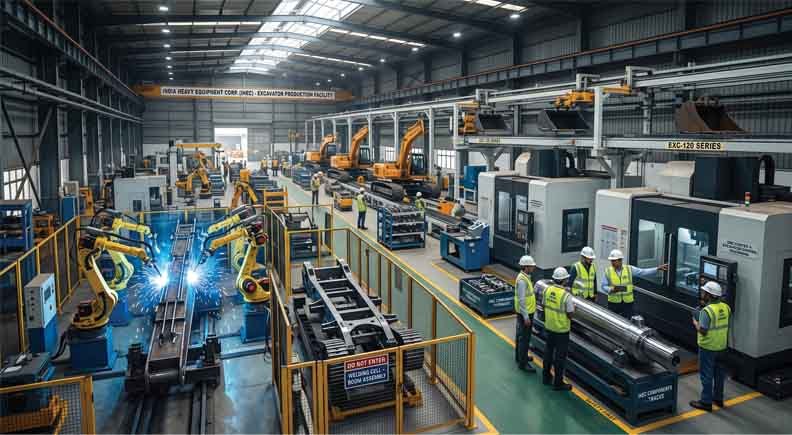
Viewed together, these developments reveal something important. The construction equipment revolution is not taking place inside a single machine. It is unfolding across an interconnected industrial ecosystem where every supplier, manufacturer, and technology partner contributes to overall project performance.
The Human Equation
For all the discussion surrounding automation, artificial intelligence, connected fleets, and intelligent machines, one reality remains unchanged. Construction continues to depend on people.
Operators, technicians, service engineers, maintenance teams, fleet managers, welders, mechanics, and project planners collectively determine how effectively equipment performs on the ground. This makes the industry’s workforce one of its most valuable assets.
Contractors across the country continue reporting shortages of experienced operators capable of handling sophisticated equipment. At the same time, newer machines require a different set of skills. Digital displays, machine diagnostics, telematics platforms, and automated operating functions demand greater technical familiarity than traditional equipment. Training therefore assumes far greater importance than before.
Many manufacturers are expanding operator training programmes, simulator-based learning, and digital support platforms to help customers maximise equipment performance. Dealer networks are investing more heavily in technical capability, recognising that responsive service directly influences customer productivity. Safety is also receiving greater attention.
Cabin ergonomics, operator visibility, vibration reduction, climate-controlled environments, and fatigue management are increasingly viewed as productivity features rather than luxury additions. A comfortable operator is often a more efficient and safer operator over extended working hours. The discussion extends beyond project sites into manufacturing as well.
Sustainability, process efficiency, and responsible production are becoming central themes across industrial operations supporting the construction sector.
As Saket Agrawal, Managing Director, MSP Steel & Power Ltd says that sustainable manufacturing and operational excellence will remain fundamental as the steel industry supports India’s expanding infrastructure ambitions.
The message is clear. Future-ready infrastructure depends not only on advanced machines but also on skilled people capable of operating, maintaining, and continuously improving them.
2030 Starts Today
Preparing this anniversary feature revealed an interesting pattern. Every conversation approached the future from a different direction. Some industry leaders focused on automation. Others highlighted manufacturing, localisation, advanced materials, sustainability, or operational efficiency. None claimed there was a single technology capable of transforming construction equipment on its own. Instead, every discussion pointed toward integration.
Machines are becoming more intelligent. Manufacturing is becoming more precise. Materials are becoming more advanced. Service networks are becoming increasingly digital. Project execution is becoming more data-driven. At the same time, operators, technicians, and engineers continue playing an equally important role in ensuring these advancements translate into real productivity on project sites. That collective evolution may ultimately define Construction Equipment Revolution 2030.
The coming years are unlikely to be remembered for one breakthrough machine or one disruptive technology. They are more likely to be recognised for how multiple innovations came together to improve efficiency across the entire construction ecosystem.
India’s infrastructure ambitions continue expanding with every passing year. Meeting those ambitions will require more than larger machines. It will demand connected equipment, resilient supply chains, stronger manufacturing, advanced materials, skilled professionals, and technologies that solve practical challenges on the ground. If the conversations with industry leaders featured in this anniversary edition are any indication, that transformation is already well underway. The revolution is not waiting for 2030. It is steadily taking shape on construction sites across the country today.