

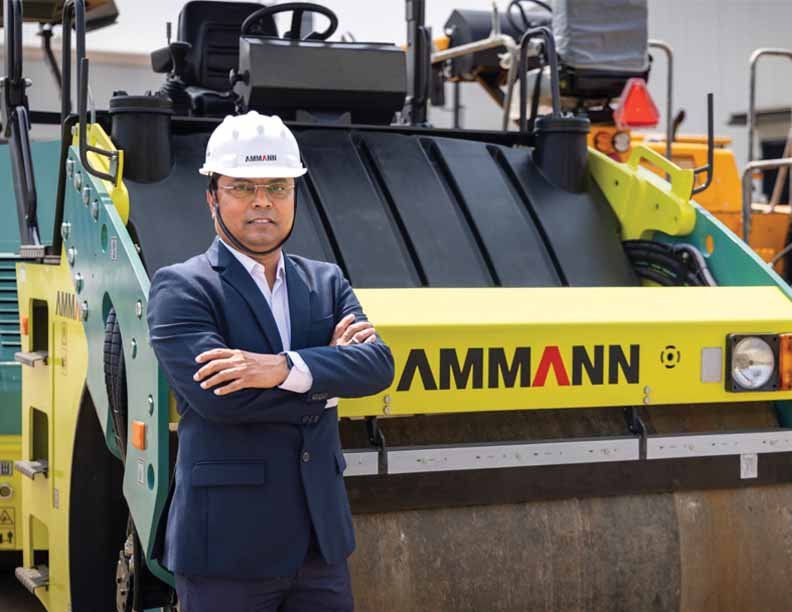
Ammann India Engineering the Next Phase of Road Infrastructure
India’s rapid infrastructure development is creating demand for construction equipment that delivers higher productivity, consistent quality and lower lifecycle costs. In this interaction, Dheeraj Panda, MD, Ammann India, discusses automation, intelligent compaction, sustainability, localisation, after-sales support and the company’s growth priorities in India’s evolving road construction market.
With India’s road infrastructure programme continuing at pace, how are evolving project requirements influencing the design and development of Ammann’s asphalt and compaction equipment?
India is aiming to build roads at industrial velocity, and that is rewriting the engineering brief for every machine we design. With sustained budget commitment to highways and a vast pipeline of two-to-four and four-to-six lane upgrades, the order books are visible for years. As equipment makers, our job is to make sure the machine is never the bottleneck.
The focus is increasingly shifting towards higher productivity, predictable quality, longer service life and lower resource intensity. For Ammann, this means the equipment requirement is becoming more project specific. Large highway EPC projects demand high output and continuous operation, while urban and regional projects require greater flexibility, mobility and cost efficiency.
We see this segmentation influencing both our product strategy and customer engagement. For large corridor projects, solutions such as the ValueTec series of Asphalt Batch-mix plants, with output of up to 260 tonnes per hour, are designed to support sustained production. Technologies such as as1 automation software and ACE intelligent compaction help contractors maintain consistency and reduce rework. For Tier 2 and Tier 3 markets, the opportunity is different, with greater emphasis on versatile, compliant and locally supported equipment.
Our view is that the next phase of growth will favour manufacturers that can combine output with measurable lifecycle efficiency. Contractors will increasingly evaluate equipment on productivity, fuel consumption, quality consistency, compliance and service support rather than upfront machine cost alone. Ammann’s strategy is therefore to compete across these parameters, while increasing localisation and developing solutions suited to the diverse requirements of India’s infrastructure market.
The industry is placing greater emphasis on automation and digitalisation. How are intelligent controls and connected solutions changing the way customers operate and maintain Ammann equipment?
Energy efficiency, emissions reduction and material circularity are moving from being sustainability ambitions to becoming commercial considerations for contractors. Our view is that the technologies that will gain traction fastest are those that reduce resource consumption without compromising productivity or output quality.
At Ammann, we are therefore approaching this across the complete asphalt production and compaction cycle. Our plants can currently incorporate up to 60% Reclaimed Asphalt Pavement (RAP), with systems such as RAH60 and the ABP HRT series supporting a roadmap towards 100% RAP integration. We are also working with alternative materials including waste plastics, fly ash, rubber and steel slag, while rejuvenator injection can help restore aged bitumen and improve the reuse of reclaimed pavement material.
Energy efficiency is another area where the economics are becoming increasingly compelling. Foam Bitumen Warm Mix technology can reduce production temperatures by around 50°C to 60°C and deliver fuel savings of up to 25%. On compactors, Intelligent Eco Mode can reduce fuel consumption by up to 30%, while electric solutions such as the eARX 26 2 roller can enable zero local emissions in suitable applications.
Looking ahead, we believe the bigger shift will be towards measuring sustainability through material savings, fuel consumption and lifecycle economics. Technologies such as RAP, warm mix, alternative fuels and electrification will become increasingly relevant as contractors seek to reduce both their environmental footprint and operating costs.
Which innovations in your product portfolio are making the biggest impact on productivity and operational efficiency?
The innovations making the biggest impact are those that directly improve productivity while reducing the variability and operating costs of a project. From our perspective, the real test of innovation is whether a contractor can produce more consistent output, minimise downtime and achieve the required quality with fewer resources.
Automation is one of the strongest productivity levers. The as1 Control System enables precise material metering, automated quality control and real time recipe adjustments, helping plants maintain consistent output even when material or operating conditions change. High output plants such as the ValueTec series can deliver up to 260 tonnes per hour, which is particularly relevant for large infrastructure projects where production continuity directly affects project timelines.
On the paving and compaction side, technologies such as ACE intelligent compaction provide pass by pass density feedback. This allows operators to reach target density with fewer passes, reducing rework, fuel consumption and machine hours.
The next level is connecting these capabilities. A Cloud IoT and Service Link allow contractors to monitor equipment condition and service requirements, moving equipment management from reactive maintenance towards more predictive intervention.
Ultimately, I believe the most important innovation is not any individual feature. It is the integration of automation, machine intelligence, connectivity and energy efficiency into the contractor’s workflow, because that is where technology begins to translate into measurable productivity and lower lifecycle cost.
As India’s road construction market becomes increasingly competitive, what factors do you believe will define the next phase of growth for equipment manufacturers operating in this segment?
India’s road construction equipment market is becoming more competitive, but I believe the next phase will be defined less by machine price and more by measurable project economics. Contractors will increasingly evaluate equipment on total cost of ownership, productivity, uptime, quality consistency and the ability to meet evolving environmental requirements.
Digital capability will be an important part of this shift. Technologies such as ACE intelligent compaction, automated paving and connected equipment can help contractors reduce rework, optimise machine utilisation and move from reactive to predictive maintenance. As machine-controlled construction becomes more prevalent, these capabilities are likely to move from being differentiators to becoming standard expectations.
At the same time, sustainability will increasingly be evaluated through its impact on operating costs. Higher RAP utilisation, warm mix technologies, alternative fuels and electrification can reduce material and energy consumption while supporting environmental objectives. Ammann’s plants currently support up to 60% RAP, with a roadmap towards 100%.
I also see local manufacturing and lifecycle support becoming decisive competitive factors. Our Gujarat manufacturing base has around 95% localisation, enabling greater responsiveness to Indian requirements while retaining global engineering standards. Combined with CEV Stage V compliant equipment, this also creates an opportunity to serve international markets.
Ultimately, the manufacturers that will gain share will be those that can demonstrate measurable value across the machine’s entire lifecycle, from productivity and fuel efficiency to uptime, operator capability and after sales support.
How has Ammann strengthened its service capabilities, spare parts network and customer engagement to maximise equipment availability?
In road construction, equipment availability is ultimately a business continuity issue, not simply a service metric. A machine sitting idle can affect labour utilisation, material planning and project schedules, so our approach is to treat after sales support as part of the machine’s overall productivity proposition.
At Ammann India, we have built a network of more than 200 service engineers across the country, supported by the Ammann Careline for technical assistance. Connected solutions and remote diagnostics are also helping our teams identify issues earlier and reduce troubleshooting time, particularly as equipment becomes more electronically controlled and automated.
Spare parts availability is another critical factor. Our 13 regional spare parts depots, supported by our central warehouse at our Gujarat facility, enable faster distribution of critical components. With more than 95% localisation, we also have greater control over supply chain responsiveness. For larger projects, we work with customers to pre-position critical spares based on equipment utilisation and operating conditions.
The other shift is towards preventing downtime rather than simply responding to it. Through Ammann Academy, we equip operators and technicians with the skills required for correct operation, maintenance, safety and diagnostics, including simulator-based training for complex systems.
Our objective is therefore to measure service by equipment availability and customer productivity, rather than simply by how quickly a service call is closed. That lifecycle approach will become increasingly important as contractors expect greater uptime from increasingly sophisticated equipment.
With infrastructure investments expanding across highways, airports, industrial corridors and urban development, what opportunities do you see shaping Ammann India’s growth strategy over the next five years?
Over the next five years, I believe Ammann India’s growth opportunity will come from the changing nature of infrastructure investment, rather than infrastructure spending alone. Highways will remain an important market, but growth across airports, industrial corridors, urban infrastructure and regional connectivity will create demand for equipment that can deliver higher productivity, precision and lifecycle efficiency across different applications.
For Ammann, this creates three clear opportunities. The first is deeper localisation and manufacturing scale. Our Gujarat operations give us a platform to develop equipment suited specifically to Indian operating conditions while building export potential. With around 95% localisation, we can continue increasing responsiveness and supply chain resilience.
The second is technology adoption at scale. Automation, intelligent compaction, connected equipment and predictive service can help contractors address productivity and skilled manpower challenges. Over the next five years, I expect these technologies to move increasingly from premium offerings towards mainstream construction equipment.
The third is the transition towards lower resource intensity. Higher RAP utilisation, warm mix technologies, fuel efficient equipment and electrification will become increasingly relevant as contractors face greater pressure to control both operating costs and environmental impact. Our ambition is therefore not simply to grow volumes. We aim to grow by becoming a more deeply localised, technology enabled and lifecycle focused equipment partner, serving both India’s infrastructure requirements and selected international markets.