


MB Crusher introduces On-Site Processing to India’s Construction Sites
At bauma CONEXPO INDIA 2026, MB Crusher is highlighting a practical approach to material processing, with crusher and screening buckets, a drum cutter and its new MB-PT1650 pulverizer. CEO, Guido Azzolin explains how on-site processing can reduce material movement, haulage costs and project delays while improving equipment utilisation.
Which products are you showcasing at bauma this year, and what makes them stand out?
At stand O.D15 we are running the range that Indian sites actually put to work: the BF90.3 S4 crusher bucket, the MB-L160 for loaders and backhoe loaders, the MB-S18 screening bucket, the MB-R900 drum cutter, and the MB-PT1650 pulverizer, which makes its India appearance at this show.
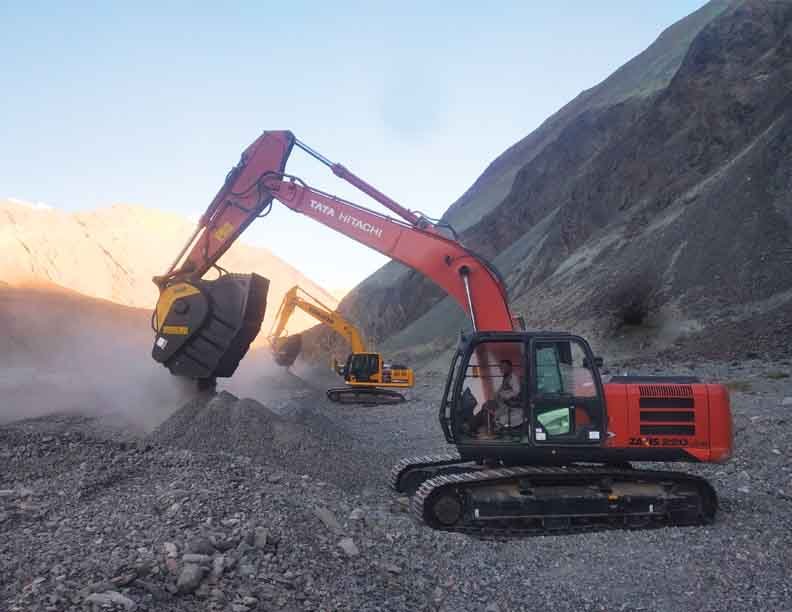
What separates these from a crushing plant is not a performance number. It is where the crushing happens. A jaw crusher bucket mounts on an excavator the contractor already owns, draws from the carrier’s existing hydraulic circuit, and produces aggregate at the point the material is lying. Nothing is loaded out, nothing is hauled in, nothing waits on a supplier’s despatch schedule.
That changes what a contractor controls. On a rural road package, granular sub-base usually arrives by truck from a quarry fifty to a hundred kilometres away, and the project timeline is hostage to that truck. Crush on site and the timeline belongs to the contractor again.
We will be demonstrating live through the show, For anyone who has not seen a crusher bucket at work, the numbers on a spec sheet can feel abstract. That is why our stand is built around a live demonstration: ten minutes of material going through the machine is worth more than any brochure.
What industries are driving the highest demand for your crusher and screening attachments in India?
These machines earn their place wherever moving material costs more than processing it. That single test explains our position in India better than any list of sectors would.
Look at what the applications have in common rather than what separates them. Rock from an excavation, concrete from a demolition, spoil from a cut face, oversize a primary plant will not accept — in every case the material is already on site, and the contractor has a choice. He can move it somewhere to be dealt with, or he can deal with it where it lies. When the transport side of that equation is expensive, slow, or simply unavailable, on-site processing is the better answer. Where haulage is cheap and reliable, it is not, and we would say so.
That is why the sectors look diverse but behave identically. Road construction, urban redevelopment, demolition, quarrying, mining, tunnelling — the label on the project changes and the underlying arithmetic does not. The contractor is weighing a truck movement against a crushing cycle, and the answer follows from his site conditions rather than his industry.
What has changed over the past decade is less about which sectors use these machines and more about how the decision is made. The conversation used to be about what the equipment costs. Now it is about what the material movement costs, and that is a more useful question for everybody in this business.
How do your solutions help contractors reduce project costs and improve productivity?
There are three costs a contractor stops paying, and they are worth separating.
The first is the material itself. Sub-base bought from a crusher site is a purchase. Sub-base produced from the excavation on your own alignment is not.
The second is haulage, which is usually the larger number and the one that gets underestimated. Trucks, diesel, drivers, loading time, waiting time, and the cost of a delivery that does not arrive on the day it was promised.
The third is manpower. A crusher bucket is a single-operator system. The man in the excavator cab is the entire crushing crew. On sites where skilled operators are scarce and supervision is thin, removing a separate plant, its feed loader and its attendants is not a marginal saving.
Productivity follows the same logic. The attachment runs off the carrier’s hydraulics, so there is no second engine to fuel, no genset, no separate mobilisation. Setup is a pin change. When the crushing is done, the same excavator goes back to excavating.
On projects with steady sub-base consumption, our customers consistently report that the attachment pays for itself within the project cycle and then carries into the next project with no further capital outlay. The precise figure always depends on actual quantities on site: that conversation is one we are happy to have with any contractor considering the equipment.
Are there any new technologies or product upgrades being introduced at the exhibition?
The MB-PT1650 pulverizer is the significant introduction for India. It is a double-cylinder unit for excavators in the 19 to 25 tonne class, with 360-degree continuous hydraulic rotation and three interchangeable jaw kits — crusher, pulverizer and shear — on a common main frame. That last point matters more than the force figures. A contractor doing primary demolition, secondary concrete reduction and rebar cutting has historically been buying three tools. Here he buys one frame and changes kits. It runs without a booster, which keeps it compatible with hydraulics already in the field.
What support and after-sales services do you provide to customers across India?
After-sales service is what determines whether a contractor comes back for a second machine.
Any attachment in this category requires scheduled maintenance and consumable replacements as a matter of course. What differentiates suppliers is what happens when that moment arrives on a live project, with a deadline in play.
We have built our support structure in India around that reality. The priority is simple: when a contractor needs a part or an engineer, the answer has to come quickly and from close by.
Training is the other pillar. We work alongside customers on their own sites and their own material, because real operating conditions are the only meaningful training environment. For anyone evaluating this category on purchase price alone: acquisition cost is the smallest number in the total cost of ownership. It is the quality of support over the life of the machine that makes the real difference — and that determines whether a contractor chooses the same supplier again.