


Keeping Moisture Out: Why Dry, Clean Air Matters for Machinery
Moisture is often treated as an unavoidable part of operating machinery. But when humid, contaminated air enters hydraulic systems, gearboxes, storage tanks or transformers, it can trigger a chain reaction of corrosion, oil degradation, wear and ultimately costly maintenance. GIEBEL Group has made the prevention of moisture damage its core mission. We spoke with Heinrich Laas, CEO of GIEBEL Group, about why air exchange can become a major source of damage — and why prevention is more effective than repairing the consequences.
Heinrich, why is moisture such a serious problem for industrial machinery?
Moisture is often underestimated because its effects are not always immediately visible. Every time a system breathes to equalize pressure, humid and contaminated air can enter. Over time, this can trigger corrosion, contamination, oil degradation and increased wear.
What happens when moisture enters hydraulic oil, for example?
Water promotes corrosion, and the resulting particles can become hard and abrasive. It can also accelerate oil degradation and affect its additives, changing properties such as viscosity and lubricity. The result can be sludge, clogged filters, affected valves and increased wear.
Can this happen even in systems that appear to be completely closed?
Absolutely. Pressure and temperature changes cause systems such as hydraulic reservoirs to breathe in and out. Without appropriate filtration and drying, every breathing cycle can introduce moisture and dirt.
What are the warning signs?
Condensation, free water, rust, contaminated or unusually dark oil, poor lubrication and signs of abrasion are clear warning signs. But damage can develop long before these symptoms become visible. That‘s why prevention is so important.
So where do adsorbers come into the picture?
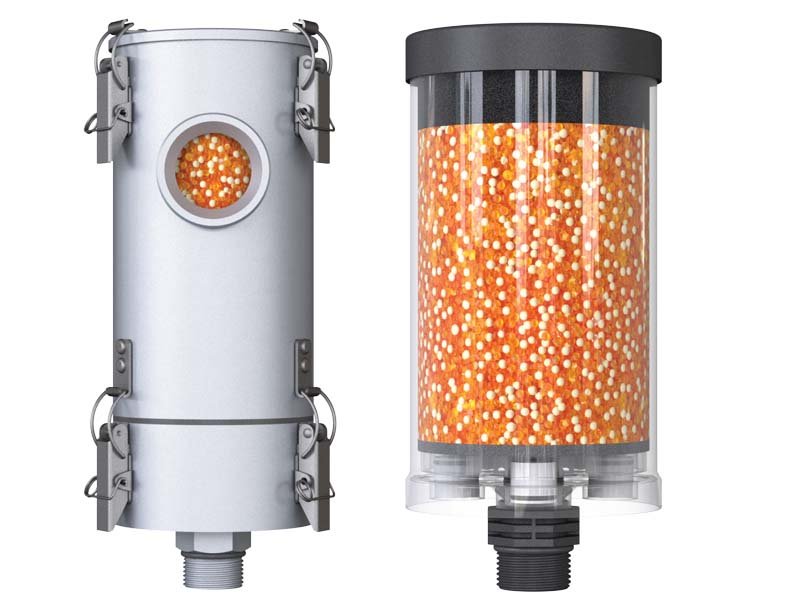
A GIEBEL Adsorber® acts as a protective barrier between the machine and the surrounding atmosphere. It dries and filters incoming air, removing moisture and dirt before they reach the system. When the system breathes out, it also helps prevent oil mist and pollutants from escaping. In other words, we are addressing the problem at its source rather than waiting for contamination and its consequences to appear.
What does this mean for maintenance?
Maintenance is often reactive. Something deteriorates, an inspection identifies the problem, and then someone has to intervene. That can mean changing oil, replacing filters or components, cleaning systems or, in the worst case, dealing with an unexpected machine failure. Our philosophy is different: prevent the contamination in the first place.
You also emphasize sustainability. How does moisture prevention contribute to that?
Sustainability in industry is not only about energy consumption. It is also about making machines, components and operating fluids last longer. If we can help extend the useful life of machinery and operating fluids, we are reducing that resource consumption.
Does that mean the cost of moisture is much greater than simply changing oil or filters?
Exactly. Maintenance costs are only part of the picture. There are also labor, downtime, troubleshooting, lost production and the cost of shortened component life. Prevention can therefore have a much greater economic impact than it may initially appear.
What do you think companies most often get wrong when it comes to moisture protection?
The biggest mistake is assuming that if a machine is running, everything is fine. Moisture-related damage often develops gradually and remains unnoticed until the consequences become expensive. Companies should not only ask how contaminated their oil is, but also how that contamination is entering the system.
If you had to explain the value of a GIEBEL Adsorber® in one sentence, what would you say?
Keep the air dry and clean, and you protect everything downstream.
Finally, what is your vision for GIEBEL Group?
Our vision is very straight forward: we want to help companies prevent moisture damage before it happens. We develop highly effective adsorber filters and desiccant mixtures because we believe industrial equipment should be more durable, more efficient, more sustainable and less dependent on maintenance. For us, the ideal maintenance job is the one you never have to perform because the damage never occurred in the first place.
That is what drives us at GIEBEL Group.
From reactive maintenance to preventive protection. The conversation with Heinrich Laas highlights a deceptively simple industrial principle: air entering a machine is part of the operating environment — and it needs to be treated accordingly. For operators, the potential benefits go beyond protecting a single component. Longer oil life, reduced wear, fewer maintenance interventions, lower downtime and reduced environmental emissions can all contribute to a more reliable and sustainable operation.